
NEW EXHIBIT:
Driven by Design
Opens November 22, 2025: “Driven by Design: The STEAM Behind Pop Culture’s Iconic Rides”. Powered through the generosity of Fox Rothschild LLP, this immersive experience invites visitors of all ages to explore real replica movie vehicles, and the STEAM (Science, Technology, Engineering, Arts, Math) principles behind them. The exhibition offers an engaging experience with iconic rides from some of the most beloved movies of all time.
EXPLORE THE RIDES
-
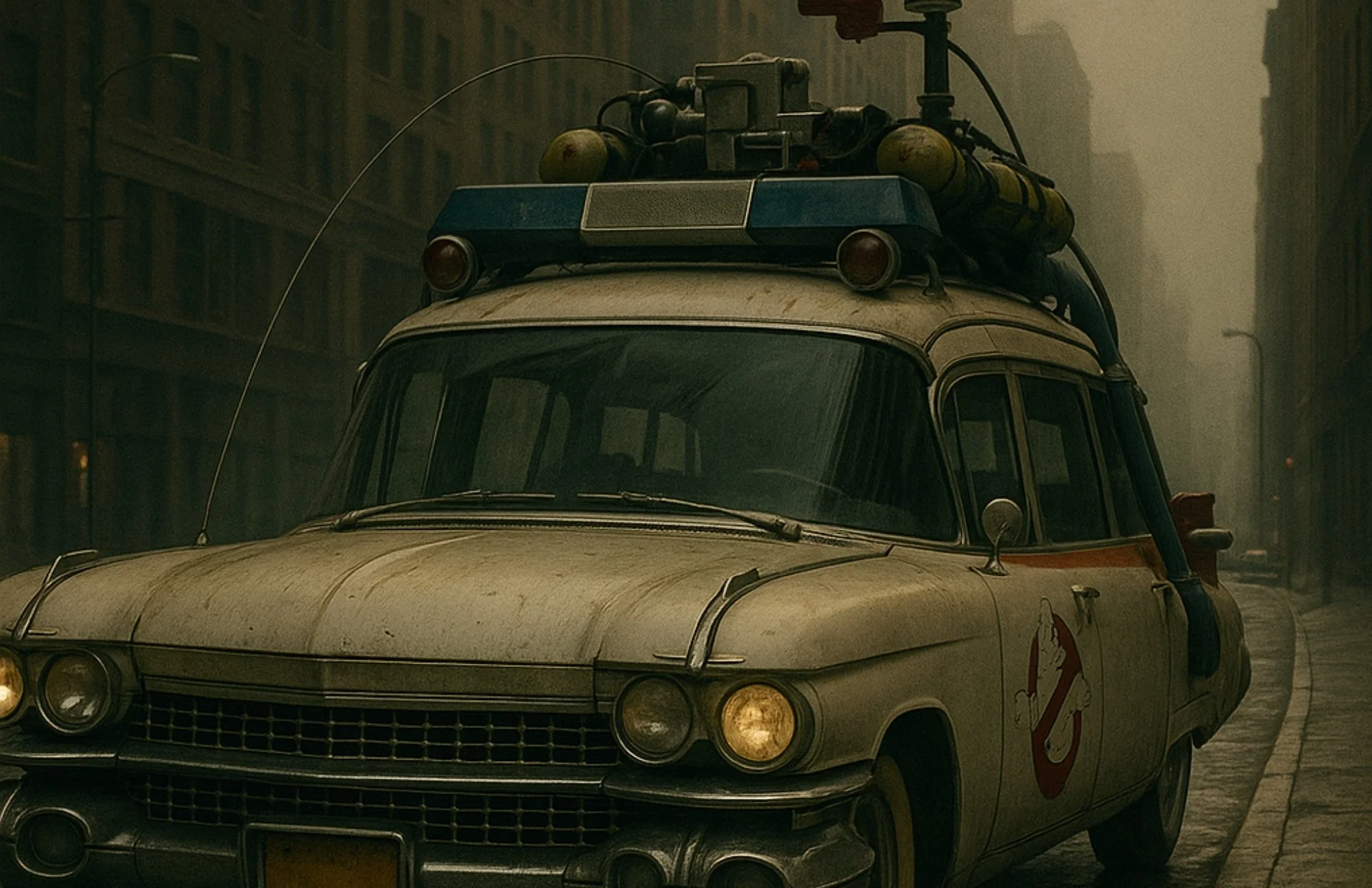
Ghostbusters Ecto-1
Behind the Scenes: “Who ya gonna call?” Ecto-1 began life as a real 1959 Cadillac Miller-Meteor ambulance/hearse, which the filmmakers transformed into the Ghostbusters’ iconic ride. At nearly 20 feet long and 3 tons in weight, it was unwieldy to drive. Imagine taking those tight turns in what is essentially a small bus! Dan Aykroyd and Harold Ramis originally envisioned the car being black with purple strobe lights and supernatural abilities (able to dematerialize and travel between dimensions), giving it a spooky aura. They ultimately changed it to the now-familiar white paint scheme – a practical decision because many scenes were filmed at night, and a black car wouldn’t show up well on camera.
Amazingly, wildlife played a role, too! The vehicle's iconic siren sound was created by sound designer Richard Beggs - he edited a real leopard's snarl!
STEAM Behind Ecto 1 – Art, Nature and Engineering: Ecto-1 provides a lesson in automotive technology and design. Being a 1950s car, it had features like an air suspension system that made the ride smooth despite its bulk. Air suspension works using compressed air in place of steel springs to level out heavy loads, a concept in mechanical engineering. The car’s big V8 engine (6.3 L, ~320 hp) was needed to move a 3-ton vehicle around the set.
The Ecto-1’s flashy roof equipment and gadgets did not actually function, but each was crafted to suggest scientific devices: radar, sensors and storage for ghost traps – an exercise in creative design. The Ecto-1 celebrates the “A” in STEAM too: the art of prop design, where artists and engineers collaborated to retrofit a real car with imaginative tech. This is where form meets function: how do you modify a car to handle extra weight (the props) and electrical load (all the lights/sirens)? Ecto-1 demonstrates problem-solving in both real-life car restoration as well as the exploration of “fictional” tech.
-
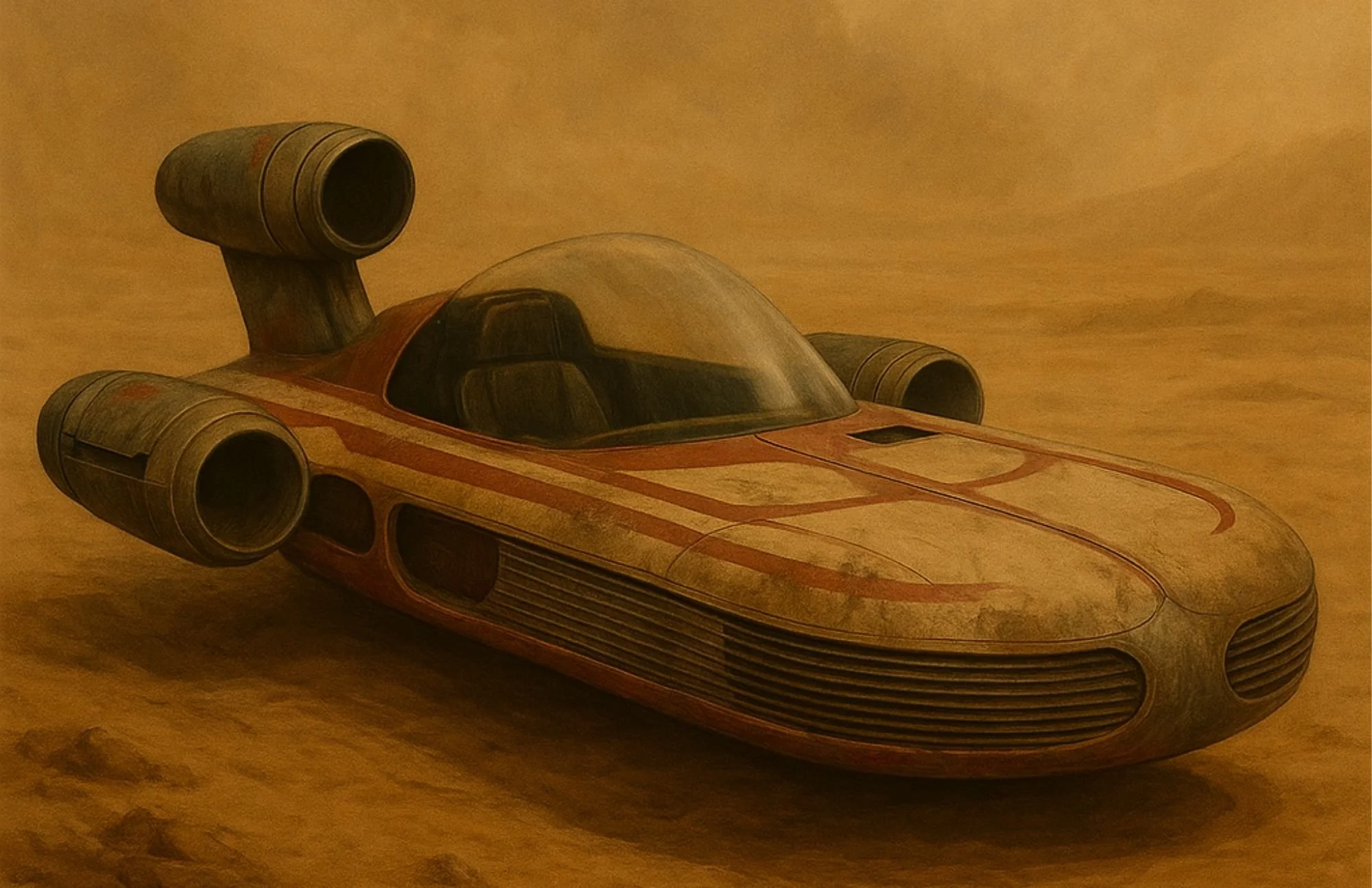
Star Wars Landspeeder
Behind the Scenes: Luke Skywalker’s Landspeeder in Star Wars: A New Hope (1977) wasn’t really levitating – it was a clever illusion. The prop speeder was built on the chassis of a small three-wheeled car (a Bond Bug), which could drive in the desert. To make it appear to hover, the film crew mounted angled mirrors along the sides of the speeder to reflect the ground and hide the wheels. In wide shots, they even smeared Vaseline on the camera lens near the bottom to blur the area where wheels might be seen. This low-tech trick fooled our eyes, making the Landspeeder look like it was floating above the sands of Tatooine – an ingenious example of practical effects before CGI.
STEAM Behind the Landspeeder – Science Meets Technology: The Landspeeder prompts a discussion about hover technology. In the film it’s “anti-gravity,” but in real life, hovercrafts use air cushions or magnetic levitation (maglev) the way trains float above tracks using electromagnetic forces. What would it take to make a real Landspeeder? For instance, hovering vehicles would need to overcome gravity – using thrust or magnetic repulsion – whereas Luke’s Landspeeder was actually using optical technology to simulate anti-gravity. This is where science fact and movie magic differ, and how early filmmakers were like engineers solving problems, using mirrors and camera tricks as technology, to create convincing illusions.
A real-world hovercraft (air cushion vehicle) is the most practical method for a direct physical recreation of a Landspeeder's movement. A hovercraft operates on the principle of reducing friction by floating on a cushion of pressurized air. However, for a vehicle that achieves actual flight without direct reliance on the ground surface, eVTOL technology is the available, albeit complex and expensive, solution. The fictional Landspeeder’s "repulsorlift" technology that pushes against gravity itself remains science fiction.
-
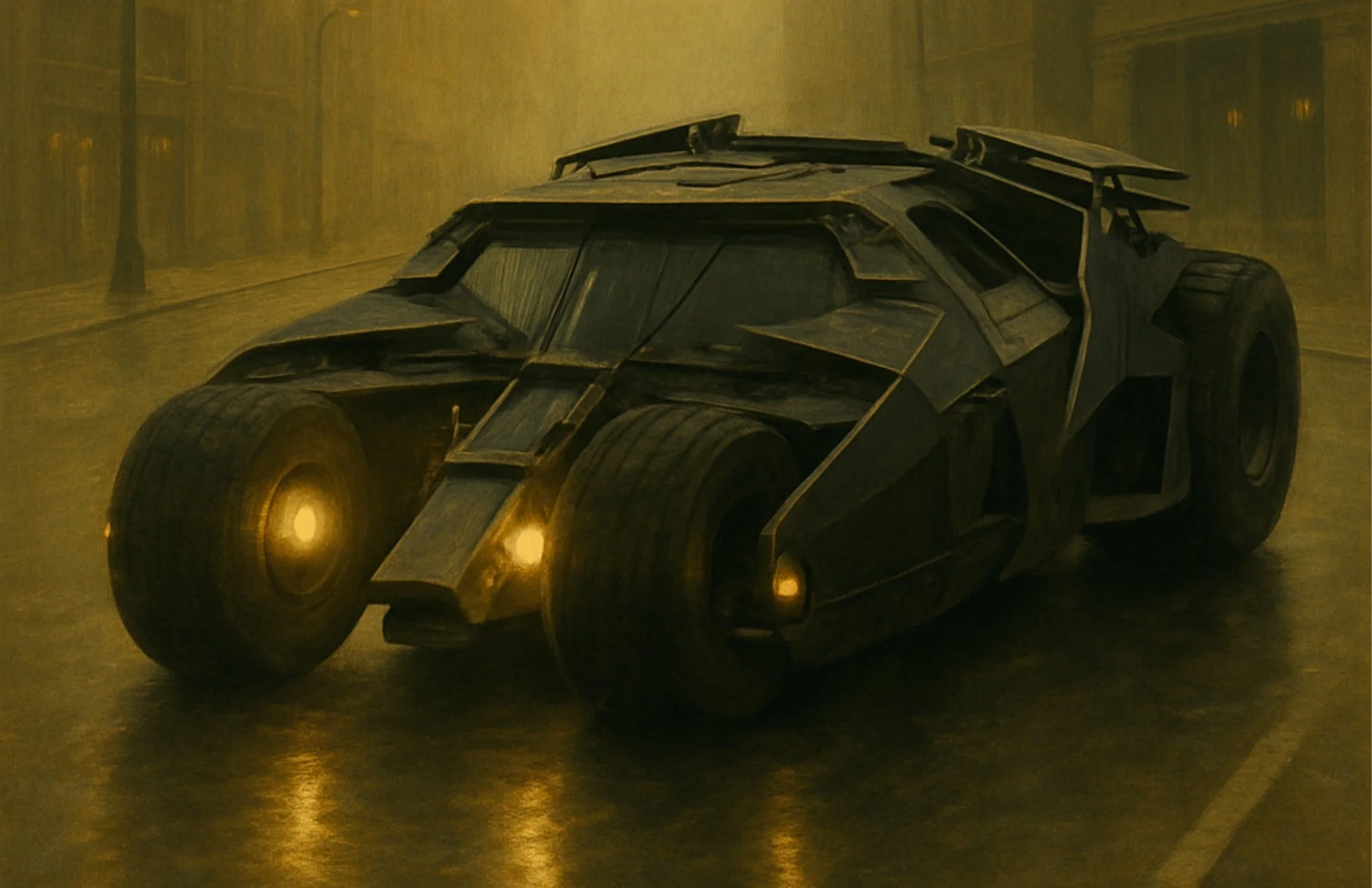
Batmobile Tumbler
Behind the Scenes: Christopher Nolan’s team designed the Tumbler, largely in secret in his garage, as a fully functional vehicle from scratch – not just a fiberglass prop. Powered by a 5.7-liter V8 engine (~400 horsepower), it could accelerate 0–60 mph in 5.6 seconds and reached about 100 mph. In fact, it was so fast for a movie car that it outran the camera trucks during filming. Weighing 7,000 pounds with huge off-road tires, the Tumbler could even jump 30 feet and land intact, performing its own stunts on set!
The original Batmobile for the 1966 TV series was built by custom car designer George Barris. He built it in 1965, basing it on a 1955 Lincoln Futura concept car, and it was completed in just three weeks.
STEAM behind the Batmobile – Engineering & Physics: The Tumbler Batmobile from The Dark Knight trilogy is grounded in real-world military engineering principles and the use of practical effects, unlike earlier, more fantastical Batmobiles. The Tumbler exemplifies extreme automotive engineering to perform its own stunts. Its design was described as a cross between a Lamborghini sports car and a military Humvee, giving it both speed and toughness. Engineers combined a racecar engine with a reinforced chassis and advanced suspension to absorb jumps and rough terrain.
How do you land a 3.5-ton car safely from a 30-foot jump? Simply put, ENGINEERING. A unique design feature is the absence of a front axle; the large front wheels were supported externally, a departure from conventional car engineering. The vehicle had reinforced suspension to withstand the impact of large jumps and rough terrain. This is the creative engineering that made comic-book technology such as stealth mode and jet propulsion, a reality on screen.
-

Jurassic Park Jeeps
Behind the Scenes: In Jurassic Park (1993), there’s an exciting scene where a Jeep Wrangler is chased by a T. rex. The question everyone asks: Could a Jeep really outrun a Tyrannosaurus rex? Also, the film’s fearsome “velociraptors” were not exactly what they seemed. Real velociraptors were much smaller in reality – about the size of a turkey, only 1.6 feet tall – and likely had feathers! The movie took creative liberty, scaling them up to human-sized and leaving the feathers off. In fact, the creatures in the film are more accurately based on a dinosaur called Deinonychus, but “velociraptor” sounded cooler for the scripts. Ironically, shortly after Jurassic Park was released, paleontologists discovered a larger raptor in Utah and actually named it Utahraptor, joking that Spielberg’s movie “predicted” its size. The Jeep itself in the film was a 1992 Wrangler Sahara edition, painted grey with red stripes and the park’s logo – and fans today love replicating these Jeeps down to the exact paintjob and JP vehicle ID number on the side.
STEAM Behind Jeep vs. Raptor – Biology and Physics: Jurassic Park pits biology vs. engineering in a fantastical race: Jeep vs T. rex vs Velociraptor. Using research from paleontologists, we estimate dinosaur speeds: T. rex, with its huge 15–20-foot stride, is thought to have maxed out around 20–25 mph at a sprint. Some newer studies even say big T. rex might have been slower (a fast walk of 5 m.p.h.) to avoid injuring itself. Velociraptors (the real ones) were speedy for their size, roughly 24 mph in short bursts – that’s about as fast as the fastest human sprinters! The larger raptor species (like Deinonychus, the movie version) are estimated around 18–25 mph top speed. Now compare: a Jeep Wrangler’s top speed is 100+ mph on road; but off-road on muddy jungle terrain, let’s say it might safely go 30 mph. In Jurassic Park, the Jeep does outpace the T. rex in the end. We confirm that in real life, a Jeep could easily outrun a T. rex – and a fit human likely could, too, in a short race of course!
But how do we know how fast any dinosaur was 65 million years ago? Scientists calculate dino speeds from fossilized footprints and leg bone analysis, measuring stride lengths and modeling muscle capability – a blend of biology and math. What gives a car its speed? Horsepower, torque and traction – why even the best dino legs couldn’t match a gasoline engine over distance! At the intersection of natural history and technology… “Could you really drive away from a charging T. rex?” Answer: yes – if your driver can keep their cool!
-

Top Gun F-5 Cockpit
Top Gun F-5 Cockpit
Behind the Scenes: The Northrop F-5 Tiger II played a starring role in real-world adversary training at the Navy’s elite TOPGUN school—so much so that several were painted in sleek black “MiG-28” markings for the iconic 1986 film Top Gun.
The aircraft used on screen weren’t Hollywood replicas; they were genuine U.S. Navy F-5s straight from TOPGUN’s aggressor fleet, temporarily transformed for the movie. The Navy relies on the nimble, hard-hitting F-5 to replicate enemy fighters during dissimilar air combat training, replacing the borrowed Air Force T-38 Talons previously used in that role. As of 2020, VFC-13 at Naval Air Station Fallon continues to fly the F-5 as a dedicated aggressor, keeping the TOPGUN tradition—and the legend of the Tiger II—very much alive.
STEAM Behind Top Gun Jets: The Northrop F-5 Freedom Fighter (F-5A/B) and its later evolution, the Tiger II (F-5E/F), were lightweight, supersonic fighters born from Northrop’s bold late-1950s vision for an affordable, high-performance jet for U.S. allies. Taking to the skies for the first time in 1959 and entering service in 1962, the F-5 quickly became one of the most widely exported fighters under the Military Assistance Program.
What does it mean to be “supersonic”? In terms of flying, supersonic speed means the aircraft is flying faster than the speed of sound, which is also referred to as a Mach number greater than 1 (Mach 1). The exact speed in miles per hour varies with atmospheric conditions (primarily air temperature and altitude), but at sea level, Mach 1 is approximately 768 mph (1,236 km/h).
-
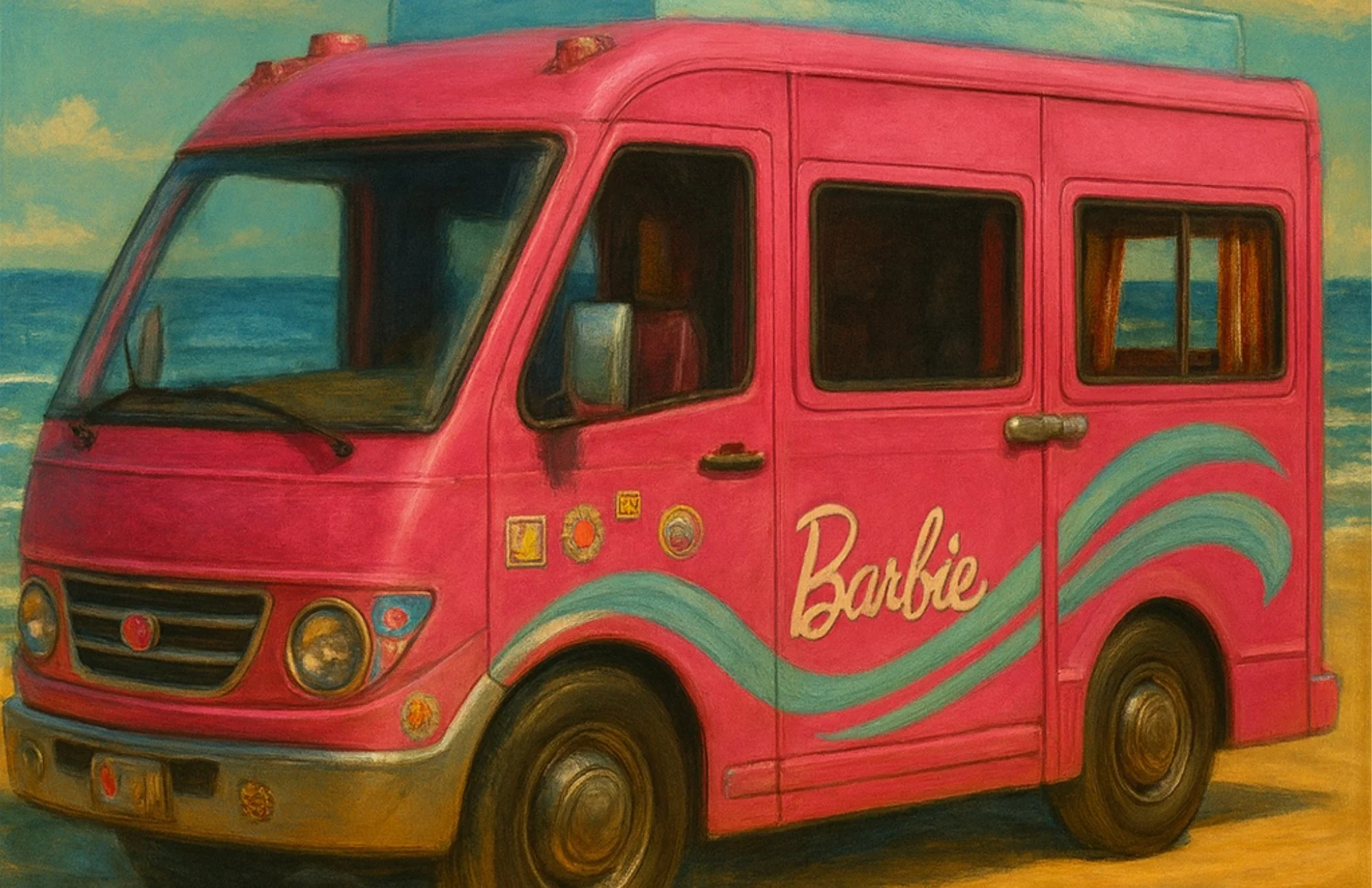
Barbie Dream Camper
Behind the Scenes: Barbie’s RV – the hot-pink DreamCamper from the Barbie (2023) movie – is a fantastical house-on-wheels that carries Barbie’s adventures from the Dreamhouse to the open road.
This iconic camper first rolled onto the scene as a toy in 1971, complete with “groovy” accessories like a pop-out tent, sleeping bags, and a picnic set. The 1970’s Country Camper was advertised as "the swinginest camper on wheels." Newer versions became even more extravagant – the 2020 DreamCamper could split into a pickup truck and a boat, with the RV turning into a party pad with a pool and waterslide. A life-sized Barbie camper was even built for a touring exhibit, proving Barbie’s RV is not just make-believe. And it has Ken feeling a little envious.
STEAM Behind Barbie’s RV – Science and Math: In the real world, an RV is an engineering marvel – designers cleverly pack a whole house (beds, kitchen, and fun included) into one vehicle, just like Barbie’s camper fits a tiny dream home on wheels. Building a camper involves applying principles from physics, chemistry, structural engineering, and systems design to create a safe, durable, and comfortable living space within a vehicle. Key areas include managing weight and balance, controlling heat and moisture, ensuring structural integrity, and designing integrated utility systems.
One of today’s most elaborate real-world RVs even has its own car garage! -
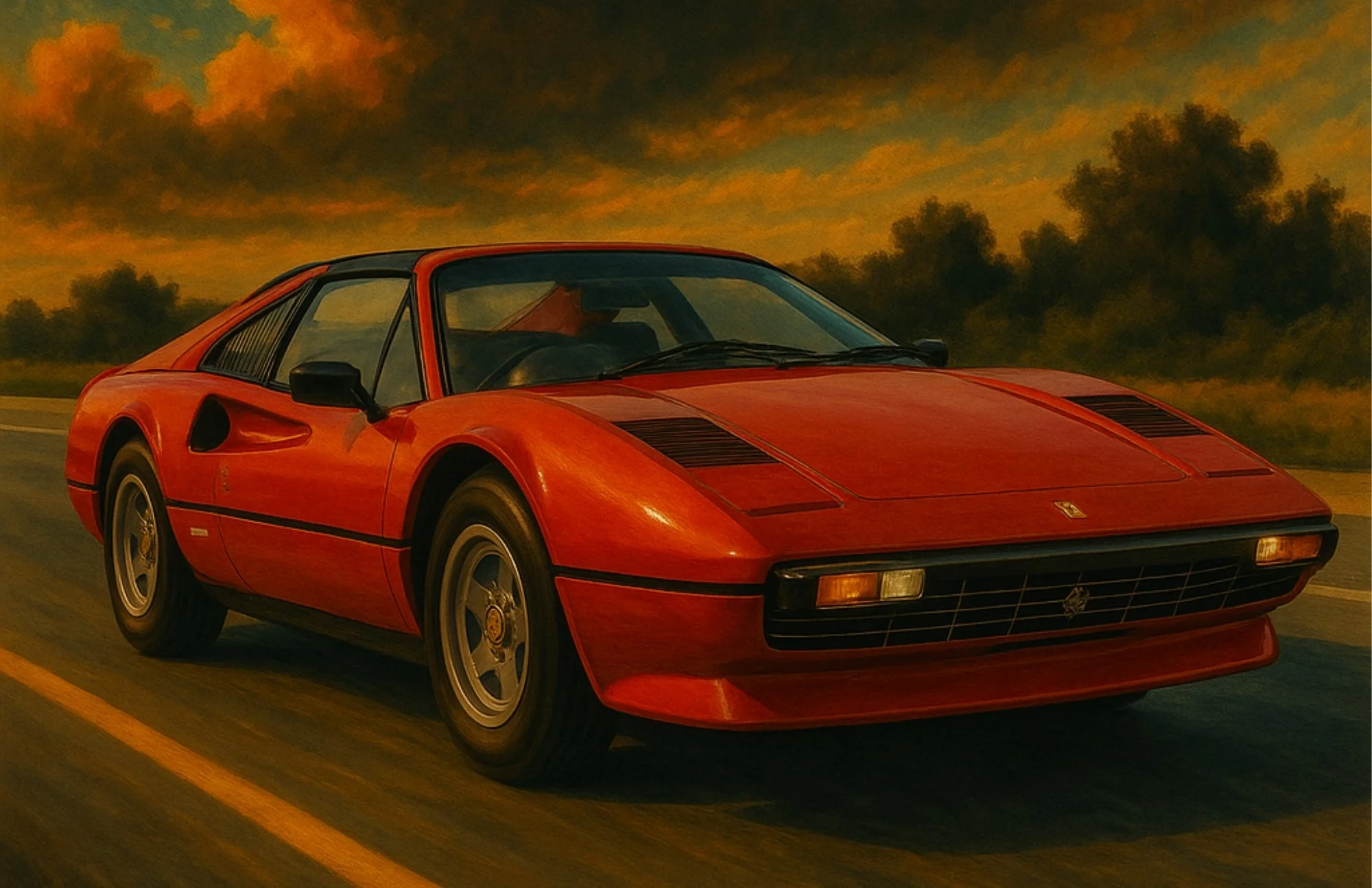
Magnum P.I. Ferrari
Behind the Scenes: On the 1980s TV show Magnum, P.I., detective Thomas Magnum zoomed around Hawaii in a sleek red Ferrari 308 GTS – an iconic ride that became as famous as the character himself. Interestingly, Magnum’s Ferrari almost wasn’t a Ferrari at all: the producers first wanted him to drive a Porsche 928, but Porsche refused to make the custom changes needed for the tall 6’4″ Tom Selleck. Instead, Ferrari stepped in with the 308 GTS and even modified it specially for the show – they removed padding from the seats and bolted them farther back so Selleck could fit comfortably while tearing down Oahu’s highways. Fans also caught the P.I. with his head popping up from the Targa open-air roof on many occasions. This behind-the-scenes tweak highlights real engineering in action. Automotive design isn’t just about horsepower and speed; it’s also about ergonomics - allowing the car and driver to interact as one.
STEAM Behind Magnum P.I.’s Ferrari – Ergonomics and Automotive Design: The Ferrari is a case study in engineering for human needs. Ergonomics, the science of designing for people, plays a key role in everything from cars to furniture to video game controllers. Here, engineers had to balance style, performance, and driver comfort. Through this lens, we can explore how engineers adapt real designs for people of different shapes and sizes—and how aesthetic dreams (like a red Ferrari under palm trees) must still follow the laws of physics, safety, and comfort.
The Ferrari 308 and its successor, the 328, are among the most iconic sports cars ever produced by Ferrari. Known for their stunning design, thrilling performance, and cultural significance, these models captured the spirit of the late 1970s and 1980s. The Ferrari 328 introduced a larger 3.2-liter V8 engine (328), producing 270 horsepower in European models and 260 horsepower in U.S. versions. The Ferrari 308 and 328 were celebrated for their engaging driving dynamics and V8 engines, which provided thrilling acceleration, a distinctive soundtrack, and a more rewarding connection between driver and machine.
-
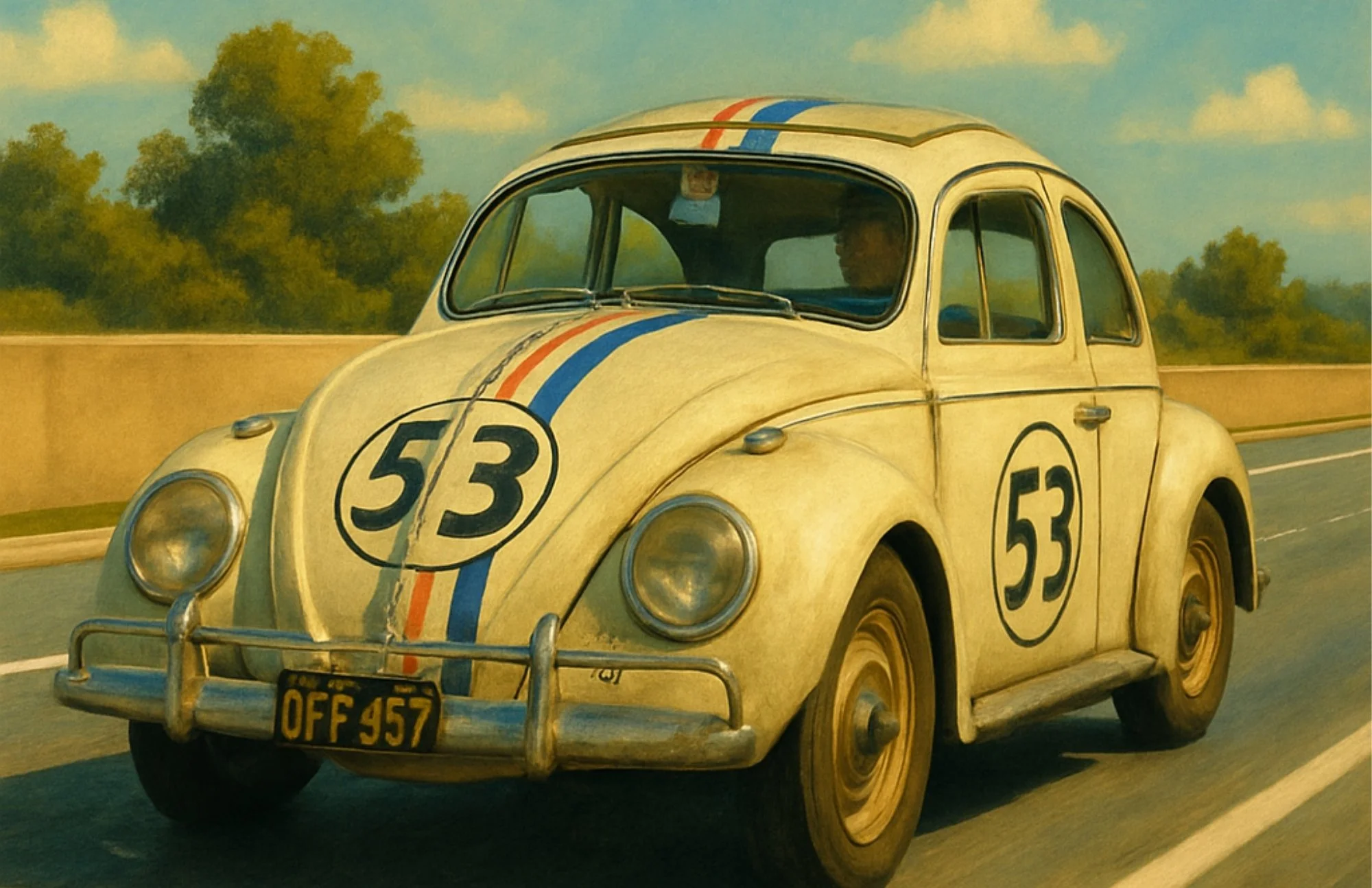
Herbie the Love Bug
Behind the Scenes: Herbie is a little car with a big personality – a pearl-white 1963 Volkswagen Beetle, sporting racing number 53, that starred in Disney’s The Love Bug (1968) and its sequels. In the movies, Herbie is alive and mischievous, often winning races and helping his human friends in need. His number “53” isn’t random at all – it was chosen by producer Bill Walsh as a nod to Los Angeles Dodgers pitcher Don Drysdale, who wore 53. Bringing Herbie to life took some movie magic: Disney used a fleet of modified Beetles for different gags. In some, a hidden driver sat in the back seat to steer so that Herbie appeared to drive himself, and in others the car was souped-up with a Porsche engine and racing suspension for extra speed.
STEAM Behind Herbie – Technology and Movie Magic: This playful use of technology and trick engineering foreshadowed real-world innovation. Today, scientists and engineers are developing actual self-driving cars – essentially teaching cars to steer and think on their own, just like Herbie - only without the fairy-tale magic.
Unlike Herbie’s moviemaking “magic”, today’s self-driving cars use a combination of sensors, artificial intelligence (AI), and sophisticated software to perceive their surroundings, make decisions, and navigate. Sensors like cameras, lidar, and radar gather data, which is then processed by AI algorithms that interpret the information to identify objects, read signs, and plot a safe path, sending commands to the car's steering, braking, and acceleration systems. Machine learning allows the vehicle to continuously learn from its experiences to improve its navigation capabilities.
-
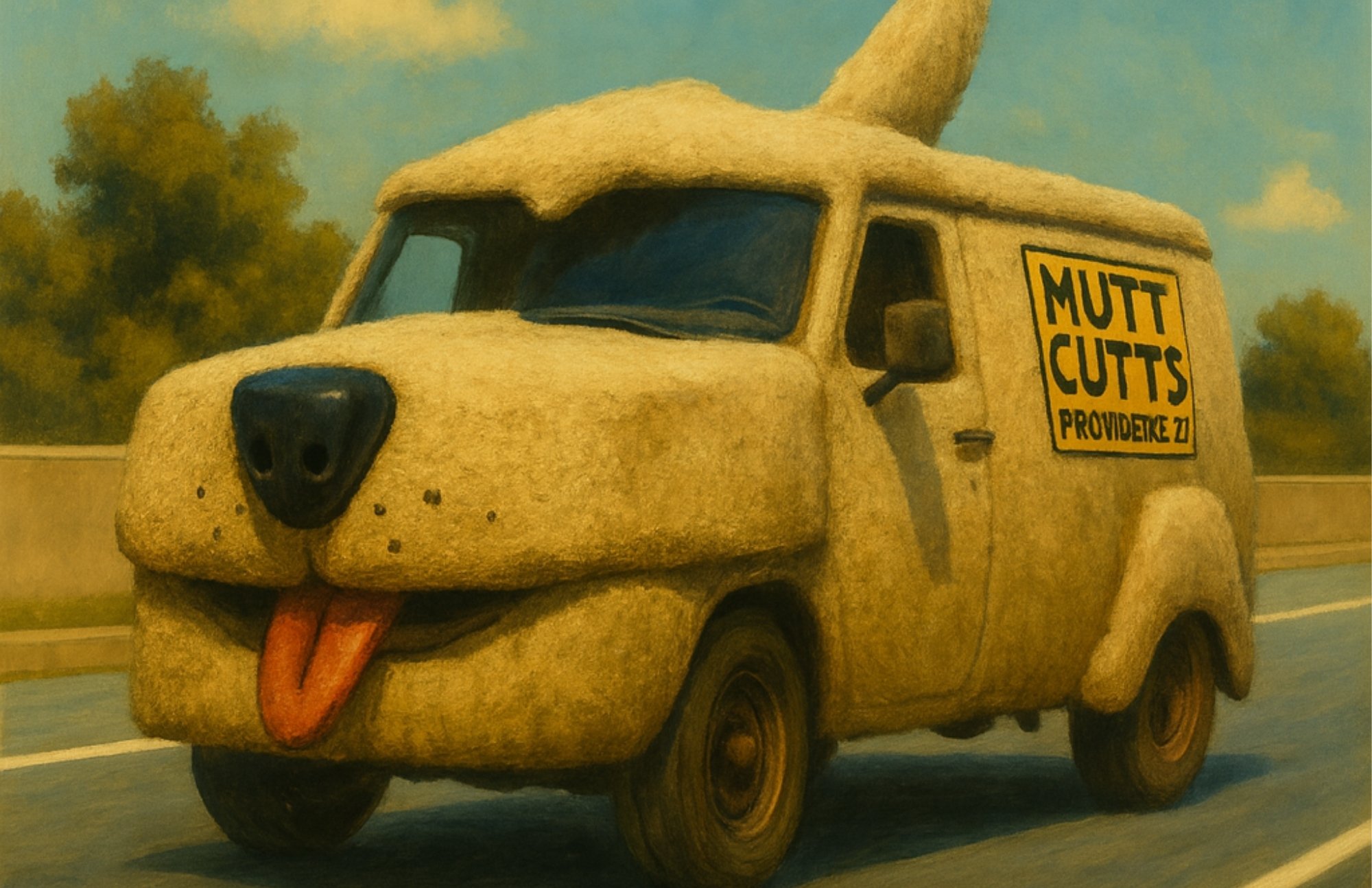
Mutt Cutts Van
Behind the Scenes: One of the goofiest vehicles in movie history is the Mutt Cutts van from Dumb and Dumber – a 1984 Ford Econoline van transformed into a giant fuzzy dog on wheels. Yes, it’s real! The film’s crew took a working Ford van and covered it entirely in shaggy carpet and fur to create the look of a shaggy sheepdog. It has a nose, ears, tail, and even claws on the front fenders. Those floppy ears actually flapped in the wind as the van drove!
One little-known tidbit: the tongue on the front was a piece of fiberglass that doubled as the van’s hood – you had to lift the tongue to open the engine compartment! The dedication to detail was so high that when it rained during filming, the fur got soaked – making the van smell like a wet dog. That’s truly art imitating life, in a not-so-pleasant way for the crew!
STEAM Behind Mutt Cutts – Art and Design: The Mutt Cutts van highlights the “A” for Arts in STEAM – specifically, the art of prop design and fabrication. Creating this van was like building a giant arts-and-crafts project on a vehicle. The process begins with a concept sketch, specification of materials (hardy outdoor carpet for the “fur” so it could handle weather), and then a careful, time-consuming process of upholstering an entire van. It’s an exercise in patience and creative design; art isn’t just painting on canvas – it can be as crazy as sculpting a whole car into a work of art.
But how does the added material affect the car’s aerodynamics and weight? What happens if you put carpet on a car – does it get louder or slower? It gets us thinking about physics, in this case air drag, in a simple way.
The Mutt Cutts van is an unforgettable moving sculpture – and it emphasizes that in STEAM, artistry and science go hand-in-hand.
-
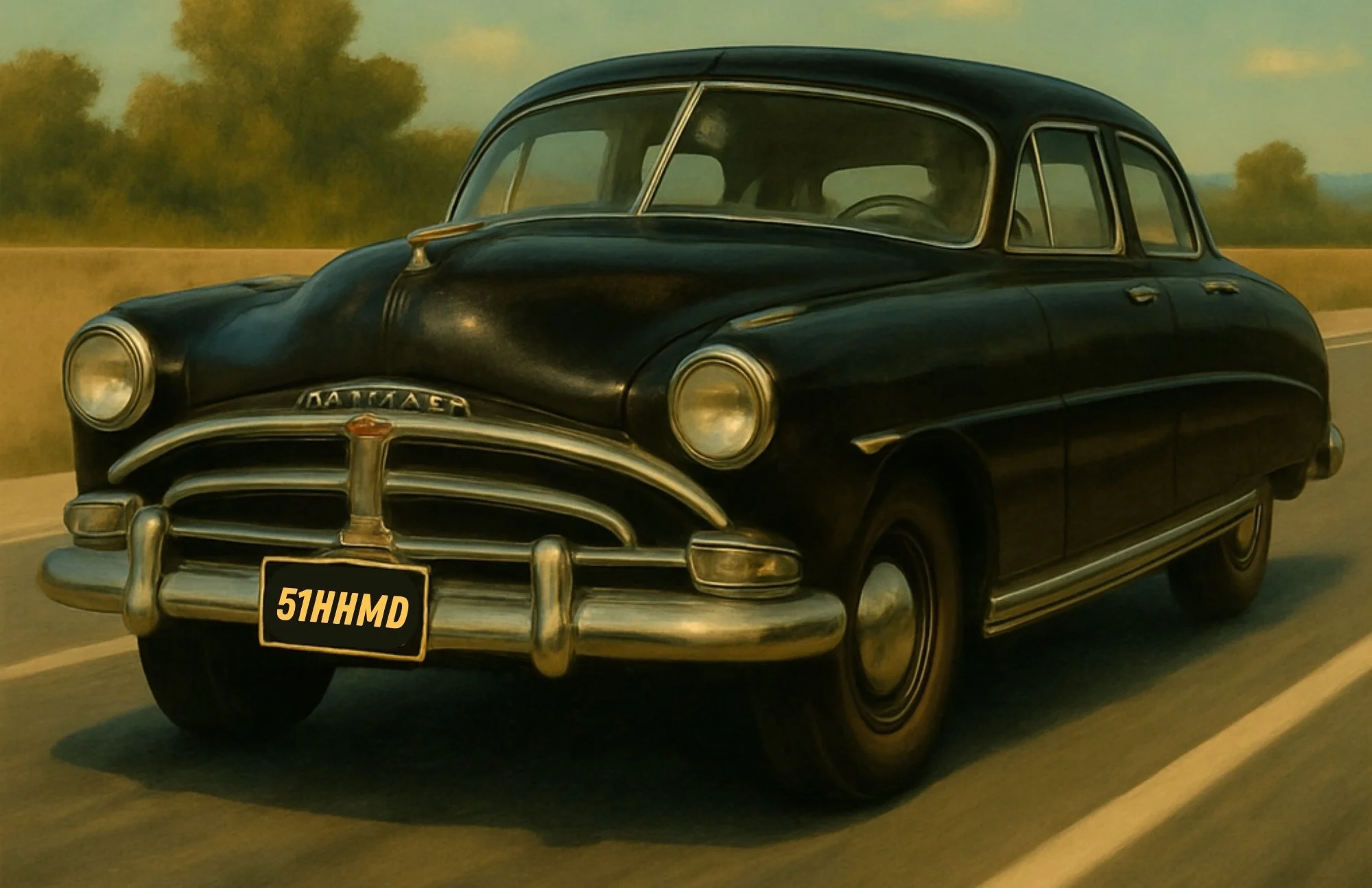
Doc Hudson Hornet
Behind the Scenes: Doc Hudson is based on the real-life NASCAR racing legend Herb Thomas, who won championships in the “Fabulous Hudson Hornet” in the early 1950s. His character's storyline was adapted after his voice actor, Paul Newman, passed away, and the Piston Cup was renamed the “Hudson Hornet Memorial Piston Cup” to honor Doc Hudson’s character.
STEAM Behind Doc Hudson – Digital Animation and Physics: The Hudson Hornet's success was largely due to its "step-down" design, which gave it a lower center of gravity, and its powerful Twin H-power 6-cylinder engine. The engineering of the car was complemented by the skill of drivers like Herb Thomas. Herb Thomas won 41 NASCAR Cup Series races on dirt, second only to Lee Petty.
The Hornet's unique design integrated the frame and floor pan into a single, rigid unibody structure, with the floor positioned lower than the door sills. This innovative construction resulted in an exceptionally low center of gravity and a wide stance, which dramatically improved handling, stability, and road-holding capabilities, especially around corners and on unpaved dirt tracks.